

Every few years, India publishes one of the largest health surveys ever undertaken anywhere in the world. Thousands of field workers travel across the country, visiting hundreds of thousands of households, collecting information on everything from maternal health and childhood nutrition to education, sanitation, chronic disease and household demographics. The result is the National Family Health Survey, or NFHS—a document usually read by epidemiologists, policymakers, and public health researchers.
Hospital CEOs rarely discuss it in board meetings.
Healthcare entrepreneurs don’t usually cite it in investor presentations.
Private equity firms seldom mention it when evaluating healthcare investments.
I think that’s a mistake.
A few weeks ago, I was preparing for a strategy discussion with a healthcare organisation that was debating its next phase of growth. The leadership team had assembled a familiar list of opportunities. Should they invest in oncology? Expand diagnostics? Launch a home healthcare business? Build AI capabilities? Acquire smaller hospitals? Strengthen digital health? Every proposal had merit, yet each competed for the same pool of capital and management attention.
As I listened to the discussion, one thought kept returning.
Before deciding where healthcare organisations should invest, shouldn’t we first understand what kind of healthcare system India is becoming?
That question led me back to NFHS-6.
At first glance, it appears to be a report about today’s health. In reality, it is something much more valuable. It is one of the earliest indicators of tomorrow’s healthcare economy.
Healthcare rarely changes because hospitals decide to innovate. It changes because societies change. Populations grow older. Families become smaller. Education improves. Insurance expands. Technology becomes commonplace. Patients begin behaving differently. Those social shifts eventually reshape healthcare delivery, often years before they become visible in hospital balance sheets.
This is precisely why NFHS deserves the attention of healthcare leaders.
When I read the report, I wasn’t searching for better immunisation coverage or changes in maternal mortality. Those indicators remain critically important, but they weren’t the questions I wanted answered. Instead, I was looking for early signals—small changes that, when viewed together, reveal the direction in which Indian healthcare is moving.
Several patterns immediately became apparent.
Individually, none of them seemed revolutionary.
Collectively, they describe a healthcare system that is quietly undergoing one of the most significant transformations in its history.
The First Signal: India Is Quietly Growing Older
For much of the past two decades, India’s demographic advantage has been one of the country’s defining economic narratives. We have repeatedly described ourselves as one of the world’s youngest nations, blessed with a large working-age population and a growing middle class. That narrative has influenced economic policy, workforce planning and, perhaps most importantly, healthcare investment.
Yet demographics are never static.
They evolve gradually, almost imperceptibly, until one day the cumulative effect becomes impossible to ignore.
NFHS-6 provides evidence that India has already entered that transition.
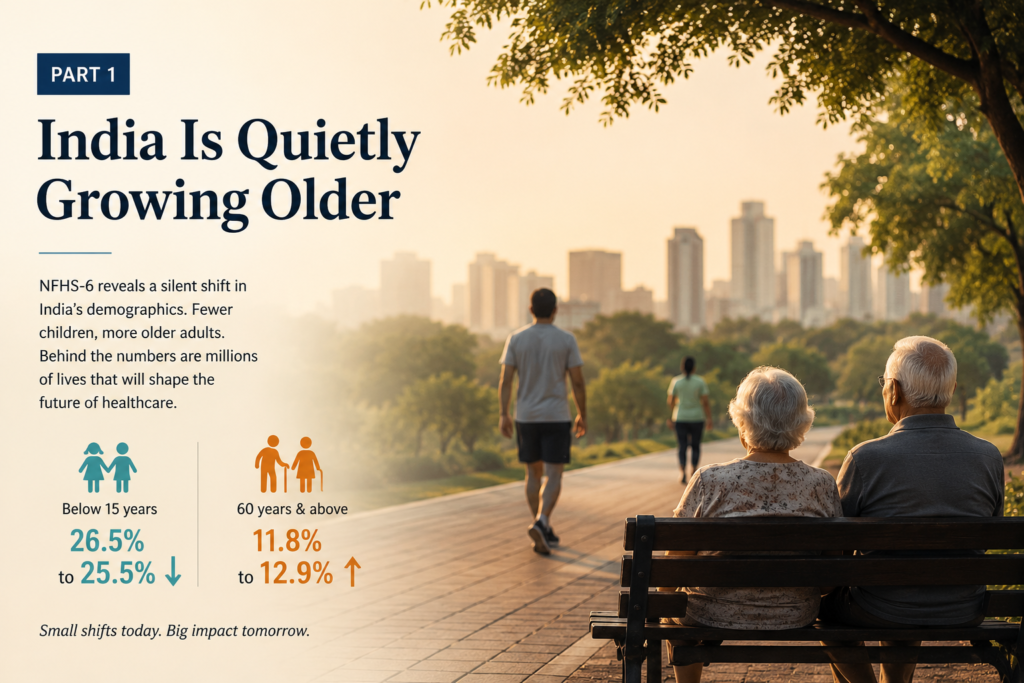
The proportion of the population below the age of fifteen has declined from 26.5% to 25.5%, while the proportion of people aged sixty years and above has increased from 11.8% to 12.9%. At first glance, those percentages appear almost insignificant. However, percentages can be deceptive in a country with a population exceeding 1.4 billion people. Behind those numbers are millions of additional older adults who will require healthcare over the coming decades.
What makes this particularly important is that ageing does not simply increase demand for healthcare; it fundamentally changes the type of healthcare that societies require.
Younger populations predominantly consume healthcare in episodes. A child develops pneumonia, receives treatment and recovers. A young adult undergoes an appendicectomy and returns to work. Pregnancy, childbirth and childhood illnesses dominate healthcare utilisation.
Older populations tell a very different story.
Healthcare becomes less about isolated episodes and more about continuous management. Patients often live with diabetes for twenty years, hypertension for thirty years, and arthritis for even longer. Cancer survival improves, but survivorship itself creates new healthcare needs. Heart attacks become chronic cardiac care programmes rather than isolated interventions. Dementia, frailty and falls emerge as significant contributors to healthcare utilisation. Rehabilitation becomes just as important as acute treatment.
In other words, ageing changes not only the volume of healthcare demand but also its character.
This distinction is often overlooked.
Many healthcare organisations continue to measure growth by the number of beds they add, the number of operating theatres they build or the number of procedures they perform. Those metrics undoubtedly remain important. However, an ageing population rewards a different set of capabilities. The organisations likely to create the greatest value over the next decade may not be those performing the most surgeries. Instead, they may be those who can keep patients healthier between hospital visits.
That requires an entirely different way of thinking.
It means investing in chronic disease management rather than simply acute care. It means integrating rehabilitation into mainstream healthcare rather than treating it as an afterthought. It means expanding home healthcare, remote monitoring and multidisciplinary care teams capable of supporting patients throughout the course of their illness rather than only during moments of crisis.
In many respects, the hospital of the future may become less important than the healthcare ecosystem surrounding it.
The real strategic implication is therefore much broader than demographics alone. Competitive advantage will increasingly depend upon an organisation’s ability to manage the entire continuum of care—from prevention and early diagnosis through treatment, recovery and long-term disease management. Hospitals will remain central to that journey, but they will no longer define it.
The demographic transition described by NFHS-6 has already begun.
Healthcare leaders who recognise it today will have years to redesign their organisations before its full impact becomes visible. Those who wait until demand becomes obvious may discover that demographic change is far easier to observe than it is to catch up with.
Stay with me on this series. This is the first signal that I have decoded. There are four other signals that we will look at in the subsequent articles.
(End of Part 1)